I happen to have a 1937 Farmall F-12 that my dad gave me when he moved and retired from the farm back in 1986. This tractor was purchased new by my grandfather in 1937 and sold to my dad when he started farming. Consequently, this was the tractor I learned how to drive when I was 5 or 6 years old. I remember pulling a 3- section harrow and 2 row stalk rotary chopper. Dad used the F-12 for mowing, run an elevator with belt pulley, haul manure and other light jobs on the farm. It was very economical to run.
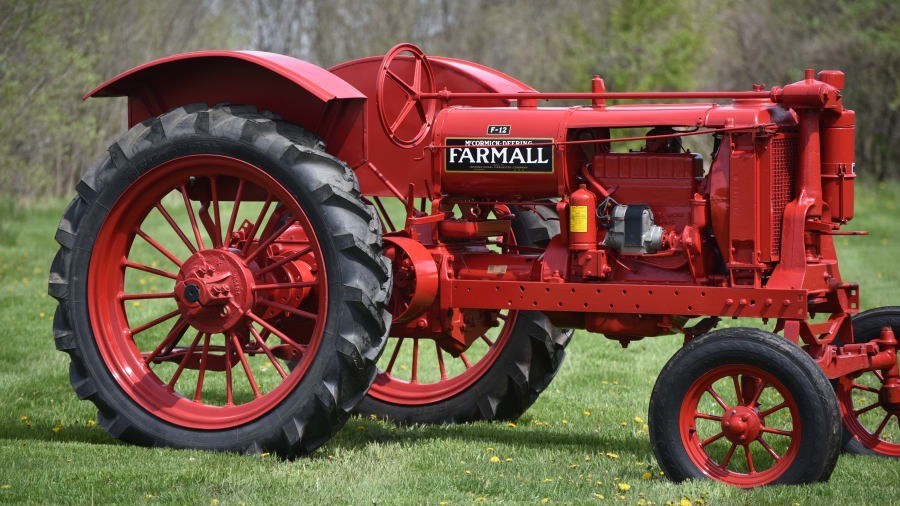
If any of you are familiar with F-12’s they start “easy” by crank first thing in the morning or day, but to start after using for farm work after shutting off then cranking to start will test your religion. They are noted for not
draft carburetor that contributed to the hard starting after warmed up and turned off.
At lunch time you would usually let it run on idle. If you stop the engine, you should park it on a hill if your yard or farm had one. After lunch when time to go to the field, put the tractor in (high) third gear make sure ignition switch is on, pull the throttle out, push in the clutch, start
coasting down the hill at a reasonable speed and let out the clutch out. It would always start by this method. You could always pull with another tractor if you had to.
About ten years ago, I decided to attempt to install a starter. I purchase a ring gear from a salvage Farmall H. Welded a round metal plate to the ring gear. Precisely drilled two holes in center to bolt the ring gear to the universal type joint between the transmission and clutch. There was not room enough for a “H” starter. I had found a 12 volt “Nissan” car starter that after several attempts in building a mounting that would fit. I had to have the Nissan starter reversed to turn the F-12 motor the right way.
After it was all said and done, and trying the first time to start, it was almost music to my ears to hear the motor spin a lot faster than cranking, and the motor starting almost right away.
Other shop-built starters I have seen have a ring gear welded to the belt pulley with starter mounted perpendicular to the ring gear under the gas tank. Another shop-built starter was a starter turning the power takeoff with a ring gear on a pulley fitting the power take off.
Starters were great inventions to keep farmers from busting or breaking fingers when cranking to start if tractor would happen to backfire or kick back when trying to start.
 Elkhorn Valley Antique Power Association